


The most important facts in brief:
Successful AI implementation is a strategic milestone for companies – it enables data-driven decisions, automated processes and long-term efficiency gains. A structured approach is crucial: from the strategic definition of objectives to the selection of suitable AI technologies and integration into existing systems. Companies that identify clear use cases, prepare their IT infrastructure and involve employees will secure sustainable competitive advantages. In this article, you will learn how to design AI integration in a practical and effective way.
Implementing AI strategically
The introduction of artificial intelligence should not be an isolated technology project – it is a strategic initiative that has a deep impact on a company’s business logic. Anyone who sees AI merely as a “tool” is wasting potential. It is crucial that every AI implementation is based on clearly defined goals that are closely linked to the overarching business objectives. This is the only way to turn technology into real business added value.
A key question here is: what exactly is to be improved or changed through the use of AI? Is it about optimized decision-making, more efficient workflows or the development of new business models? The answer to this question determines not only the technological implementation, but also the selection of use cases and the evaluation of the project’s success.
Managers are required to clarify the direction – both operationally and strategically. An AI strategy that has a long-term impact requires more than just technical know-how: it requires a deep understanding of the company’s own value chain, clear responsibilities and a measurable target architecture.
| Area | Potential AI Value |
|---|---|
| Customer Service | Automated inquiries, personalized offers |
| Production | Predictive maintenance, process optimization |
| Sales | Forecasting models, lead scoring |
| Controlling & Finance | Automated reporting, anomaly detection |
| Human Resources | Skill matching, automated recruiting |
Maturity level and prerequisites
Before a company launches an AI project, a realistic assessment of the status quo is crucial. Many AI initiatives fail not because of the technology – but because fundamental prerequisites are missing. A solid starting point forms the basis for all further implementation steps.
Data quality determines success
No AI solution is effective without high-quality, structured and accessible data. The data must not only be available, but also capable of integration and trustworthy. Data quality, diversity and availability are therefore key success factors. If you know the potential of your database, you can develop realistic AI models and successfully integrate them into processes.
Evaluate systems and infrastructure
Another prerequisite is the technical environment: IT systems, data architecture, APIs and the ability to process in real time determine how seamlessly AI systems can be integrated. Companies should evaluate whether existing solutions need to be expanded or new components integrated. Tools and platforms that are open, scalable and low-maintenance make implementation much easier.
Competencies and ability to change
The development of internal skills is just as critical as the technology itself. Departments, IT and management must be able to understand and classify AI applications and use them sensibly in everyday life. This requires skills, clear roles and a certain degree of willingness to change. Transparent communication and early training help to reduce fears and promote acceptance.
✓ Are central data sources identified, accessible, and of high quality?
✓ Are there already automated processes or workflows that AI can build upon?
✓ Is the IT infrastructure scalable and API-enabled?
✓ Does the company have in-house expertise or access to external support?
✓ Is management committed to promoting data-driven decision-making?
Identify suitable use cases
Selecting the right use case is the key lever for successful AI implementation. After all, even the most powerful AI tools will have no impact if they are not tailored to the actual challenges and goals of a company. It’s not about using AI anywhere – but where the impact on the business process is real and measurable.
Corporate goals as a starting point
A target-oriented use case is always geared towards a specific business objective – such as reducing costs, increasing efficiency, improving quality or growing sales. The importance lies in the fact that AI is not viewed as an abstract innovation project, but as a solution to a real problem. The requirements should therefore come from the specialist department, not primarily from IT.
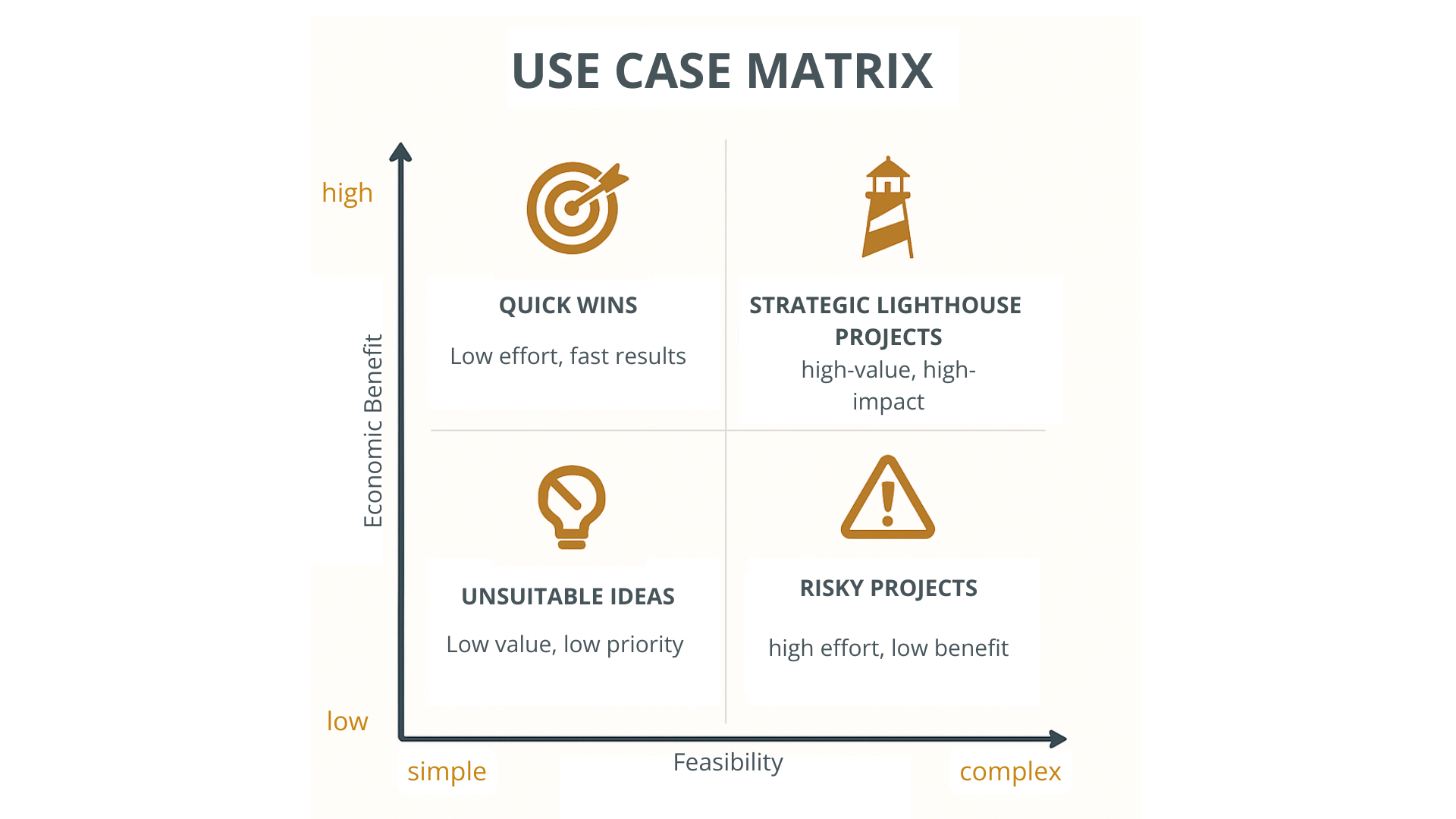
Criteria for selecting suitable use cases
Important criteria for the use case selection include
- Data basis available: Is there sufficient data quantity and quality?
- Economic added value: What direct or indirect benefits arise?
- Technical feasibility: How complex is the implementation?
- Transferability: Can the case be scaled to other areas?
- Acceptance: How likely is integration into everyday working life?
These criteria help you to make a well-founded prioritization and not get lost in a series of random ideas.
Bottom-up or top-down?
Both approaches are justified: In the bottom-up approach, employees identify problems in practice that can be solved using AI. Top-down initiatives, on the other hand, are geared towards strategic goals. In practice, a combination of both has proven successful – it creates both business benefits and cultural acceptance.
Technology and implementation
Technological implementation is the backbone of every AI implementation. Scalable AI solutions that deliver real results only emerge when systems, data and tools interact precisely. It is not just about individual tools, but about the interaction of a stable overall architecture.
Data integration as a foundation
One of the biggest obstacles in practice is the fragmentation of data. Those who think of artificial intelligence in silos are unlikely to create sustainable added value. Successful companies therefore rely on a well thought-out data strategy: they integrate structured and unstructured data sources, create central access points and define binding quality standards. Consistent data integration is the first step towards automating and optimizing complex processes.
Choosing the right technology
Today, AI systems no longer consist solely of individual algorithms – they are embedded in comprehensive technology stacks. These include:
- Data management and integration platforms
- Frameworks for machine learning and model training
- Tools for real-time analyses and visualizations
- APIs for integration into operational systems
These setups differ depending on the industry and maturity level – the completeness and expandability of the solution is crucial. On the technical side, cloud-native architectures offer clear advantages, especially if AI is to be integrated across multiple processes.
Implementation strategy: from pilot to productive operation
Ideally, the introduction of an AI system begins with a clearly defined pilot. In this phase, a use case is tested under real conditions, the model is trained and embedded in existing processes. Important: Define monitoring and success criteria at an early stage. Only when the pilot has proven to be effective is it gradually scaled to other activities or industry sectors.
| Phase | Objective |
|---|---|
| Preparation | Define clear objectives and identify the use case |
| Data Preparation | Assess data sources and ensure data quality |
| Model Development | Select, train, and validate the AI model |
| Pilot Implementation | Deploy in a live environment and measure performance |
| Scaling | Expand to additional processes and establish continuous monitoring |
Set up projects correctly
The way in which an AI project is organized and implemented is crucial to its success. In addition to technical excellence, well thought-out project management, coordinated roles and realistic planning are particularly important. Companies that take a systematic approach here avoid frictional losses and noticeably increase the business impact of their AI initiatives.
From pilot to rollout
A successful project begins with a clearly defined pilot. This is where a specific use case is implemented, tested and measured under controlled conditions. It is crucial to think about future scaling at this stage: which other processes, locations or teams could benefit from this? Only when the pilot delivers measurable values does the step-by-step rollout take place – structured, secure and scalable.
Roles, processes, governance
Without clear responsibilities, innovation quickly turns into chaos. The involvement of specialist departments, IT and strategic management must be bindingly defined from the outset. Useful roles are, for example:
- Project management with a professional and technical overview
- Data scientists for model development
- Data engineers for infrastructure and data pipelines
- Business owners from the respective specialist departments
- Change agents for communication and acceptance
Clear approval processes, time frames and coordinated risk management are also required.
Ensuring success through feedback and improvement
AI is not a finished product – it thrives on continuous learning and adaptation. This is why companies should establish a structured feedback system: From measuring the results to user evaluation and technical development. Best practices from previous projects must be documented and made usable across teams. These learning loops make the difference between a functioning prototype and a successful AI-supported transformation.
Maintain focus: Limit each project to a single, clearly defined use case.
Engage stakeholders early: Foster user acceptance through active involvement.
Measure outcomes: Define clear KPIs to evaluate project success.
Choose technology pragmatically: Prioritize solutions that are easy to integrate and maintain.
Preserve knowledge: Document project experiences and share lessons learned.
Avoid mistakes – ensure success
Even the best AI concept can fail – if typical mistakes are not recognized and avoided at an early stage. Those who provide strategic support during implementation and create realistic expectations not only increase the likelihood of success, but also build trust in AI throughout the company. It is not just tools or methods that are crucial, but above all people, communication and leadership.
Common tripping hazards
Many AI projects fail for the same reasons. These include:
- Lack of strategic embedding: projects without reference to real business objectives come to nothing
- Unclear responsibilities: Without project governance, teams get bogged down
- Expectations too high: unrealistic expectations lead to frustration
- Neglected user perspective: without acceptance in everyday life, there is no benefit
These mistakes can be avoided – through a structured approach, open communication and continuous readjustment.
Tips for project success
- Communicate clearly early on: Why are we using AI? What does it mean for whom?
- Involve stakeholders: Departments must help shape, not just be informed
- Pilot projects with a sense of proportion: not too big, but not too narrow either
- Promote learning processes: Openly address mistakes, share experiences in a structured way
- Saving knowledge internally: not just saving results in tools, but keeping them in your head
These points sound simple – but in reality they often make the difference between a “trial” and a real AI-based transformation.
Creating real added value with AI
The successful implementation of AI is not a technical project – it is an entrepreneurial transformation process. Those who take a strategic approach, define clear goals and create the necessary conditions will lay the foundations for sustainable efficiency, innovation and competitiveness. It is crucial that technology, data and people work together. After all, AI will only unfold its full value when it is meaningfully integrated into everyday life.